
Beyond Words: A Quiet Couple's Guide to Vows
Part 1: Finding Your Words (Without the Pressure)
Before you can think about speaking your vows, you need the words themselves. So let’s start with one of the biggest worries couples often carry: the belief that they have to write everything from scratch.
You absolutely do not.
Not everyone is a writer, and that is perfectly okay. The goal is not to create something impressive or original. The goal is to find words that genuinely feel like you. Instead of thinking of yourself as a writer, it can help to think of yourself as a curator — someone who gathers meaningful words that already exist.
A beautiful place to begin is by searching for simple wedding vow examples, reading poems, collecting favourite quotes, or listening for phrases that resonate deeply with your relationship. As your celebrant, I also provide gentle guidance and carefully chosen examples to help you find a starting point.
Your job is not to invent perfect vows. It is simply to notice the words that make you think: “Yes. That’s us.”
And if you do feel drawn to writing something personal, please know that simple is often the most powerful. There is no required minimum length. Your vows do not need to sound poetic, and they absolutely do not need to match your partner’s word for word or line for line. Sometimes a single sentence of appreciation, followed by a simple promise, is more moving than an elaborate speech.
For example: “I love the way you make me laugh, and I promise to always try to make you laugh too.” That is already a complete and heartfelt vow.
Let’s be honest about the part of the ceremony that can cause the most quiet anxiety: the vows.
There is a modern pressure to write your own vows — to somehow become a poet, storyteller, and public speaker all at once. But for many people, the hardest part is not finding the right words. It is saying them out loud.
And then there is the reality of saying those words in front of other people. Even at an elopement, you are rarely completely alone. There is your celebrant, your photographer, and perhaps a witness you have only just met. Even if your ceremony includes only a few close friends or family members, you may never have shared such personal feelings in front of them before.
If any of this feels familiar, I want you to let go of the idea that there is one “right” way to do vows.
Your vows do not need to be long, polished, or performative. They simply need to feel true to you.
This guide is here to gently break the process into two much more manageable parts: first, finding the words themselves, and second, choosing a comfortable way to share them.
Part 2: Gentle Ways to Share Your Vows
Once you have your words, the next step is deciding how you would like to share them. There is no single correct approach here either.
Some couples love speaking openly. Others feel deeply uncomfortable with being the centre of attention. Most people fall somewhere in between. The important thing is finding an approach that feels emotionally safe and natural for you.
1. The “Repeat After Me” Approach
This is a classic option for a reason. It is simple, grounding, and very low-pressure.
I gently guide you through your vows one short phrase at a time, and you simply repeat the words after me. You do not need to memorise anything or worry about losing your place. My role in that moment is simply to support you calmly through it.
For many couples, this creates an enormous sense of relief.
2. Reading Your Vows to Each Other
This is often the option people imagine first — and sometimes fear the most.
But something very interesting tends to happen during ceremonies. By the time we reach the vows, most couples have settled fully into the moment. A quiet sense of intimacy forms around them, and the vows begin to feel less like a public speech and more like a focused conversation between the two of them.
For extra privacy, we can also create a little more physical distance from everyone else. Some couples choose to step slightly aside and turn fully towards one another, sharing their vows quietly between themselves, out of earshot of guests or suppliers.
It can become a beautifully intimate moment inside the larger ceremony.
3. The Celebrant as Your Voice
If speaking your vows aloud feels overwhelming, there is another gentle option: you can let me speak them for you.
You still choose or write the promises that matter to you, but you share them with me beforehand. During the ceremony, I then weave them naturally into the ceremony itself.
For example:
“Sarah, Tim wants you to know that he promises to always…”
Your partner still hears your words and your intentions, but the pressure of speaking publicly disappears.
4. The Private Vow Letter
For some couples, the most meaningful vows are the ones that remain completely private.
In this approach, you each write a personal letter containing your promises to one another. During the ceremony, you simply exchange the sealed letters. Afterwards, in a quiet moment alone together, you find a peaceful place to open and read them privately.
Many couples find this creates an extraordinary sense of intimacy and emotional honesty.
5. The Symbolic Vow
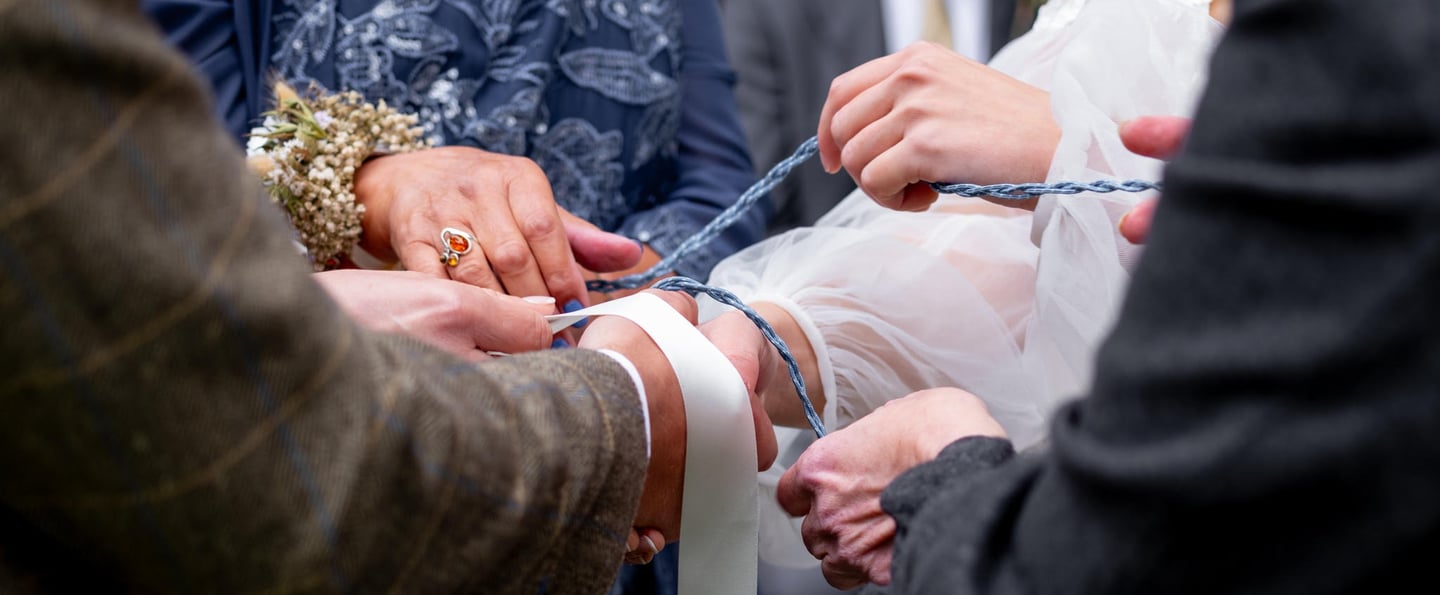
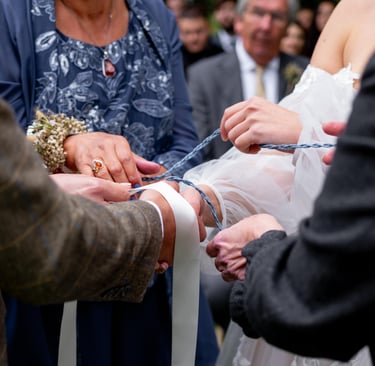
Symbolic rituals, such as a traditional Scottish handfasting, are often included alongside spoken vows. But they can also become the vow itself.
Instead of speaking promises aloud, the action and symbolism carry the meaning for you.
As your hands are gently bound during a handfasting, for example, the words spoken during the ritual can express the support, trust, strength, and commitment you are offering each other. Your role is not to perform or speak perfectly, but simply to be present with one another in the experience.
For some people, an action feels more honest and meaningful than words ever could.
A Quick, Reassuring Note on the Legal Words
For a marriage to be legally recognised in Scotland, there is one simple legal declaration that each of you must speak in front of your witnesses:
“I accept you as my husband/wife/in marriage.” That is all.
These legal words are completely separate from your personal vows, and they can always be integrated gently and naturally into the ceremony.
So if the thought of vows has been making you anxious, please know this: you do not have to perform, impress, or become someone else for your ceremony. You are allowed to choose an approach that feels calm, meaningful, and genuinely comfortable for you.